Limits and uncertainty
The analysis is based on selected frames. Exact in-between trajectories, timing and unseen changes remain uncertain unless continuous video evidence was available.
Image-to-Prompt Case · 77f2b95c
A shaded woodland pond uses dark trunks and an arched branch as a natural frame around reflective water and a small gray bridge.
This case shows that image-to-prompt work must preserve composition, negative space, lighting, color separation and explicit exclusions—not only identify the subject.
These images come from one real analysis record and are optimized for the web. Video and motion cases show start, middle and end states.
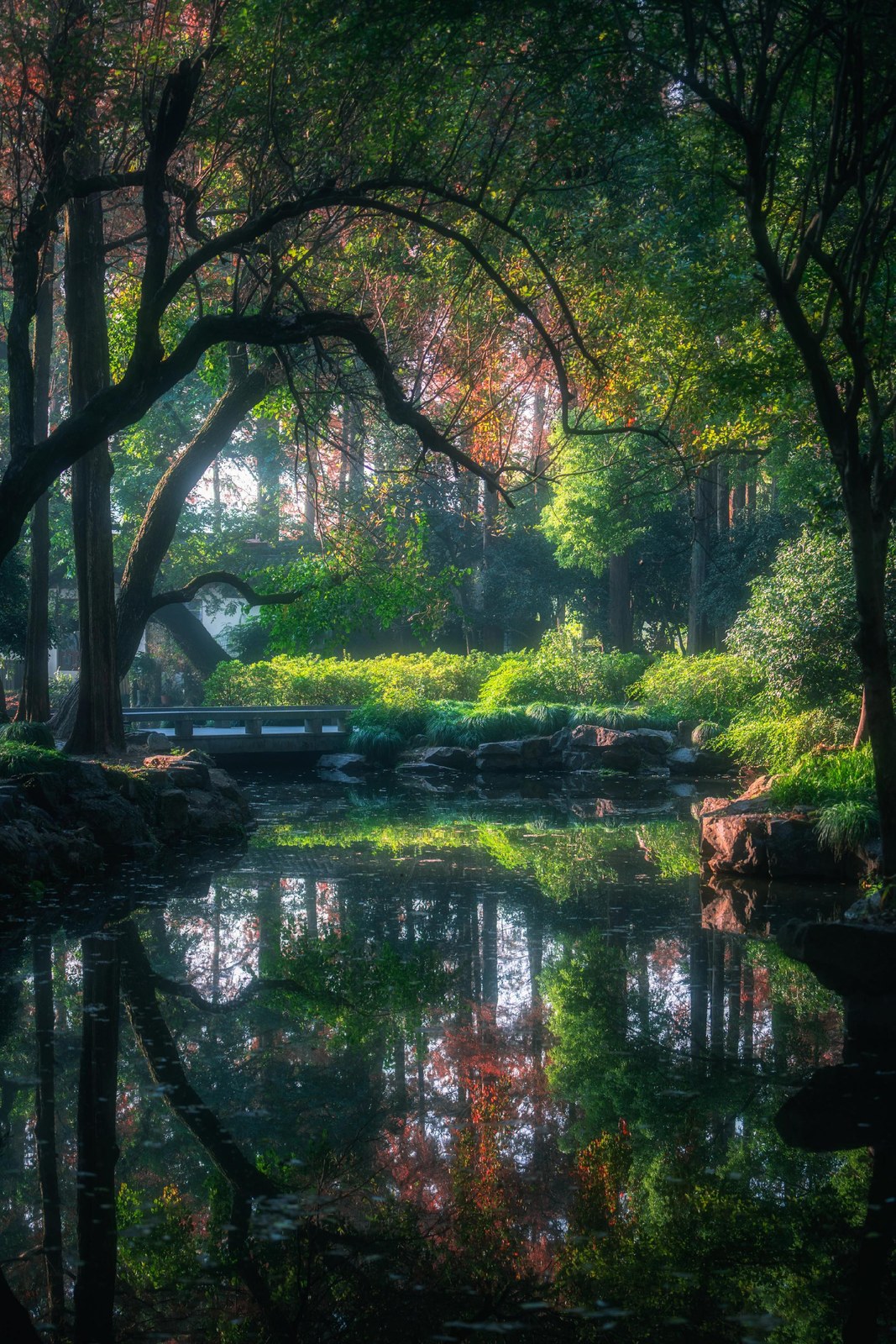
A shaded woodland pond uses dark trunks and an arched branch as a natural frame around reflective water and a small gray bridge.
This excerpt preserves the actionable structure while omitting local paths and internal run fields.
A still woodland pond enclosed by tall trees and dense shrubs. Dark water fills the lower half of the view, reflecting upright trunks, green foliage, and scattered muted red-orange leaves; very fine ripples gently fragment the edges of the reflections. A massive old tree enters from the left, sending several near-black brown limbs toward the center, with the longest branch forming a broad arch across the upper middle. Another dark tree hugs the right edge, while a thick overhead canopy closes the scene into a natural frame. Irregular rocks, soft grasses, and clustered shrubs line the middle ground. A low, simple gray bridge crosses the pond slightly left of center and is partly hidden by trunks, shadow, and vegetation. The background is layered with closely spaced vertical trunks and dense foliage, with only faint pale structural shapes visible through small gaps. Use a distant view from near eye level with a slight downward look toward the water. Build the composition around central depth and the visual echo between the canopy and its reflection. Let the curved branch guide the eye from the upper left toward the illuminated center, keeping the vegetation abundant while leaving the central water comparatively open. Natural sunlight filters through the canopy from the upper left rear, creating soft back-and-side lighting with selective dappled highlights. Keep the surrounding shadows cool teal-green and deep, while the sunlit shrubs glow yellow-green and a few red-orange leaves add restrained warmth. Preserve strong contrast without losing detail in bark, rocks, foliage, or water. Emphasize deeply ridged old bark, thin leaves with occasional translucency, damp matte stones, fine grass blades, compact leafy shrubs, and the quiet mirror-like surface with subtly broken reflections. Preserve the arched branch and its reflected counterpart as the main visual anchor, along with the low bridge, dense canopy coverage, bright central shrubs, and the balance of cool shade against warm filtered light. Do not add people, animals, boats, or conspicuous new objects.
The analysis is based on selected frames. Exact in-between trajectories, timing and unseen changes remain uncertain unless continuous video evidence was available.
This page is based on local history record 77f2b95c, analyzed with gpt-5.6-sol and the “图片反推 · 静态双语首帧” preset. It shows auditable inputs and a real prompt excerpt, without invented generated-output comparisons, ratings or success claims. The source media is displayed with permission and the website uses an optimized copy.