Limits and uncertainty
The analysis is based on selected frames. Exact in-between trajectories, timing and unseen changes remain uncertain unless continuous video evidence was available.
Image-to-Prompt Case · 9db55751
A gnarled flowering branch crosses four vertical color fields, combining a rigid geometric grid with an irregular organic diagonal.
This case shows that image-to-prompt work must preserve composition, negative space, lighting, color separation and explicit exclusions—not only identify the subject.
These images come from one real analysis record and are optimized for the web. Video and motion cases show start, middle and end states.
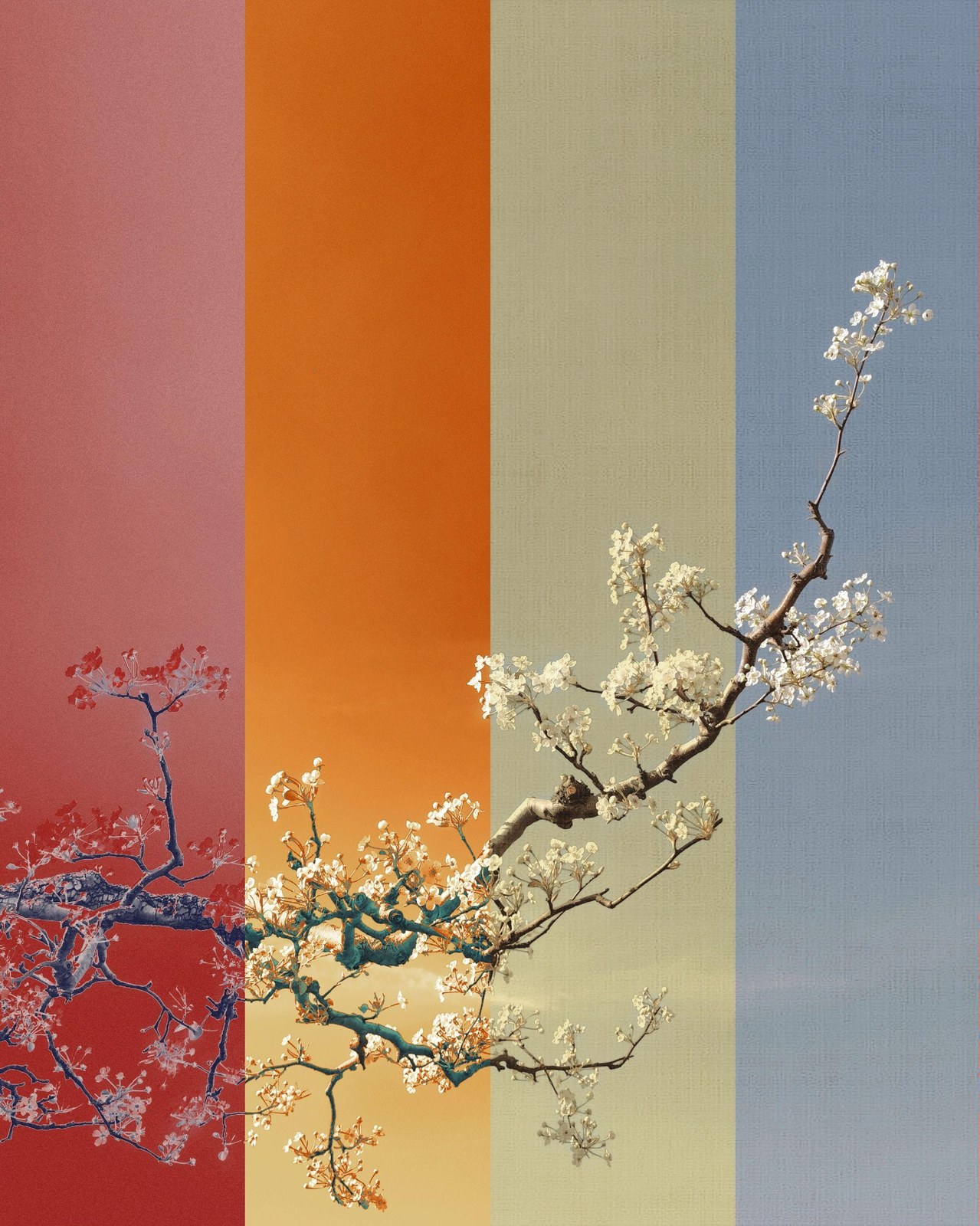
A gnarled flowering branch crosses four vertical color fields, combining a rigid geometric grid with an irregular organic diagonal.
This excerpt preserves the actionable structure while omitting local paths and internal run fields.
A gnarled flowering branch enters from the left and lower-left edges. Its thick main limb travels across the lower half, bends around a prominent knot just right of center, and sends one slender branch diagonally toward the upper right. Preserve irregular changes in thickness, cracked bark, knotted joints, and naturally twisted offshoots. Small rounded buds and delicate five-petaled blossoms grow along the finer stems. Keep the densest flower clusters around the lower center, center-right, and upper-right branch, leaving the remaining areas sparse and uncluttered.
Build the background from four adjacent vertical fields of nearly equal width. From left to right, use muted dusty rose, rich burnt orange, soft pale yellow-green, and desaturated blue-gray. Each field runs through the full height and meets the next along a straight, visible seam without decorative borders. The background is entirely flat, with no floor, sky, architecture, or distant scenery. Give every color field a fine, even linen or woven-canvas texture.
Use a close, nearly eye-level frontal view with compressed depth. The vertical divisions should create a stable geometric rhythm while the branch forms an irregular rising diagonal from lower left to upper right. Concentrate the subject across the lower half and slightly right of center, preserving broad, quiet negative space above. Let the heavy limb and a few blossoms be naturally cropped by the left edge. Place several fine stems close to the bottom edge, while keeping the upper-right tip fully inside the frame.
Introduce a localized warm golden glow in the lower center-left, illuminating the branch from the lower-left side. Petals facing the light appear bright ivory, with a few highlights approaching white while their edges remain visible. Lit bark carries warm gray and brown highlights, contrasted by deeper shaded sides. Maintain medium-high contrast, relatively crisp directional illumination, and a softer falloff around the golden glow. Do not show a physical light source.
Keep the branch structurally continuous as it crosses the four color fields, but reproduce the region-based color treatment. Against the dusty rose section, shift the branch toward deep indigo and allow some blossoms and fine stems to read as dark red or muted gray-white. Against the orange section, tint parts of the main branch teal-green and render the blossoms in warm white with subtle orange reflections. Across the pale yellow-green and blue-gray sections, return the bark to brown and charcoal tones and keep the flowers predominantly ivory. Preserve the local orange-and-teal contrast and the crisp separation of white blossoms against blue-gray.
Emphasize the fine woven ground, rough raised bark, knots and cracks, slender flower stems, bead-like buds, and thin, slightly translucent petals with a papery surface. The primary rendering feel is semi-realistic, shaped by restrained East Asian decorative composition and a subtle color-separated print or digital collage treatment. Preserve the four equal vertical divisions, the denser lower structure and sparse upper space, the center-right visual anchor, the lower-left to upper-right branch direction, the exact warm-light zone, and the large upper negative space.
The analysis is based on selected frames. Exact in-between trajectories, timing and unseen changes remain uncertain unless continuous video evidence was available.
This page is based on local history record 9db55751, analyzed with gpt-5.6-sol and the “图片反推 · 静态双语首帧” preset. It shows auditable inputs and a real prompt excerpt, without invented generated-output comparisons, ratings or success claims. The source media is displayed with permission and the website uses an optimized copy.